
Bitcoin vs Gold are two assets firmly in the public discourse and are often compared in terms of their efficacy as a store of value.
However, each has distinct characteristics and a unique appeal to investors. While both are often cited as “safe-haven” assets, their differences in nature, utility, and performance highlight the evolving landscape of modern finance. This article explores the similarities and differences in the investment case for Bitcoin vs Gold, as well as their respective investment performance.
Let’s look at the similarities in their investment cases: Bitcoin vs Gold
1. Store of Value
Both Bitcoin vs Gold are regarded as stores of value, meaning they are perceived to retain purchasing power over time. This attribute makes them attractive during periods of economic uncertainty or currency devaluation.
- Gold: Gold has been a traditional store of value for millennia, serving as a hedge against inflation and geopolitical risks.
- Bitcoin: Bitcoin, often referred to as “digital gold,” has gained similar recognition among crypto enthusiasts for its scarcity and resistance to inflation due to its capped supply of 21 million coins.
2. Hedge Against Inflation
Both assets are seen as hedges against inflationary pressures, particularly when fiat currencies weaken due to loose monetary policies or excessive money printing.
- Gold: Gold’s value tends to rise when inflation erodes the purchasing power of traditional currencies.
- Bitcoin: Bitcoin’s decentralized nature and fixed supply make it attractive to investors concerned about inflation and the diminishing value of fiat currencies.
3. Lack of Centralized Control
Neither nor Bitcoin vs Gold is controlled by a central authority.
- Gold: Gold exists naturally and cannot be manipulated by governments or central banks.
- Bitcoin: Bitcoin operates on a decentralized blockchain, immune to direct government or institutional control.
4. Global Recognition
Both assets are recognized and traded worldwide. Gold has a long-established history as a universal store of wealth, while bitcoin has rapidly gained global traction, particularly among tech-savvy investors.
Differences in Investment Case: Bitcoin vs Gold
1. Tangible vs. Digital
- Gold: Gold is a physical asset that can be held and stored. Its tangibility provides a sense of security for traditional investors.
- Bitcoin: Bitcoin is entirely digital, existing only on the blockchain. Its intangible nature appeals to modern investors comfortable with digital assets.
2. Utility
- Gold: Gold has industrial applications (e.g., in electronics and jewellery), adding intrinsic value beyond its investment appeal.
- Bitcoin: Bitcoin’s primary use case is as a medium of exchange or a store of digital value. It lacks industrial utility but benefits from its role in the burgeoning digital economy.
3. Volatility
- Gold: Gold’s price is relatively stable compared to bitcoin, making it a preferred choice for conservative investors.
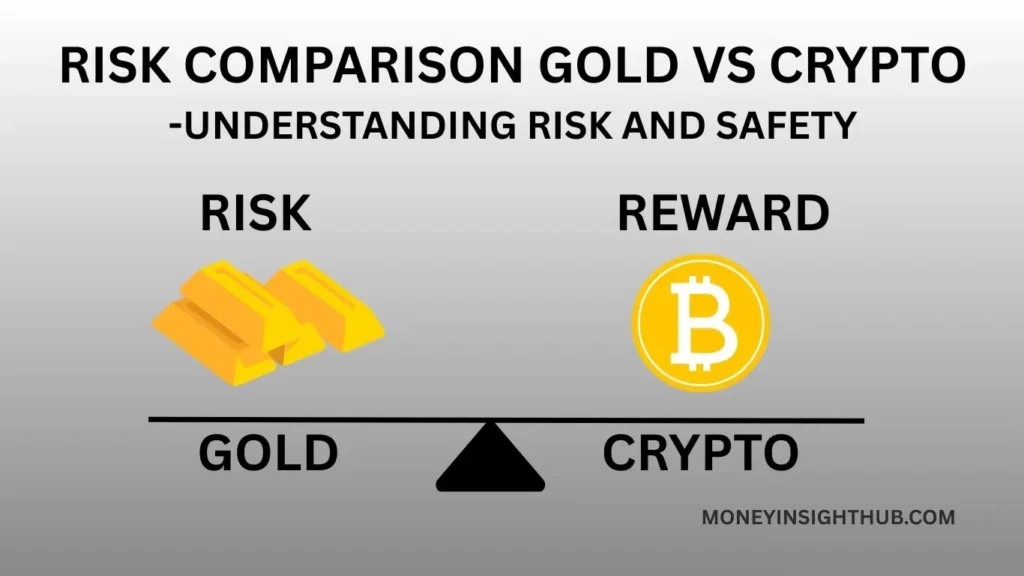
- Bitcoin: Bitcoin is highly volatile, with price swings often exceeding 10% in a single day, and its price having halved from peak to trough on several occasions, albeit whilst trending higher. This volatility attracts speculative investors but deters risk-averse individuals, and is the main reason given for why it can not be considered as a store of value, like a traditional currency.
4. Maturity and History
- Gold: Gold has been a reliable store of value for thousands of years, giving it a level of trust unmatched by any other asset.
- Bitcoin: Bitcoin, created in 2009, is a relatively new asset. Its short history raises questions about its ability to endure long-term economic challenges.
5. Regulation
- Gold: Gold markets are well-regulated and widely accepted, but are fragmented across geographies which introduces price differentials between currencies.
- Bitcoin: Bitcoin operates in a less regulated environment, leading to legal and compliance risks in some jurisdictions, and is considered synonymous with the grey economy.

Investment Performance : Bitcoin vs Gold
1. Historical Returns
- Gold: Gold’s price typically moves modestly, often in response to macroeconomic conditions. Over the past two decades, gold has provided steady returns, particularly during periods of crisis. In fact, its average return has been in excess of 10% over this time.
- Bitcoin: Bitcoin’s performance has been extraordinary, delivering exponential returns for early adopters. However, these gains have come with significant volatility.
2. Correlation with Other Assets
- Gold: Gold generally has a low and negative correlation with equities, making it a powerful portfolio diversifier. It has also proven its ability, especially more recently, to perform positively in both up and down markets.
- Bitcoin: Bitcoin’s correlation with equities has fluctuated, often behaving like a risk-on asset during bullish markets and decoupling during periods of extreme market stress.
3. Response to Macroeconomic Events
- Gold: Gold tends to perform well during geopolitical tensions, economic downturns, or inflationary periods.
- Bitcoin: Bitcoin’s performance during macroeconomic events is mixed, influenced by factors like adoption trends, regulatory developments, and market sentiment, as well as social media comments from certain influential persons.
4. Liquidity
- Gold: Gold is highly liquid, with established markets and infrastructure for trading Best Trading Apps.
- Bitcoin: Bitcoin is also highly liquid, particularly on major cryptocurrency exchanges. However, liquidity can vary depending on market conditions and jurisdiction.
Annual returns : Bitcoin vs Gold
| Year | Bitcoin | Gold spot price |
|---|---|---|
| 2024 | 135.04% | 34.65% |
| 2023 | 146.79% | 9.84% |
| 2022 | -62.02% | 5.74% |
| 2021 | 72.70% | 4.28% |
| 2020 | 270.28% | 13.68% |
| 2019 | 97.82% | 21.12% |
| 2018 | -72.13% | 3.54% |
| 2017 | 1,162.50% | -1.69% |
| 2016 | 131.62% | 12.70% |
| 2015 | 49.70% | -1.22% |
| 2014 | -50.19% | 13.38% |
| 2013 | 5,189.37% | -30.92% |
| 2012 | 183.50% | 3.64% |
Average returns : Bitcoin vs Gold
The tables below show the average returns of the Bitcoin vs Gold Gold spot price indexes over the last periods.
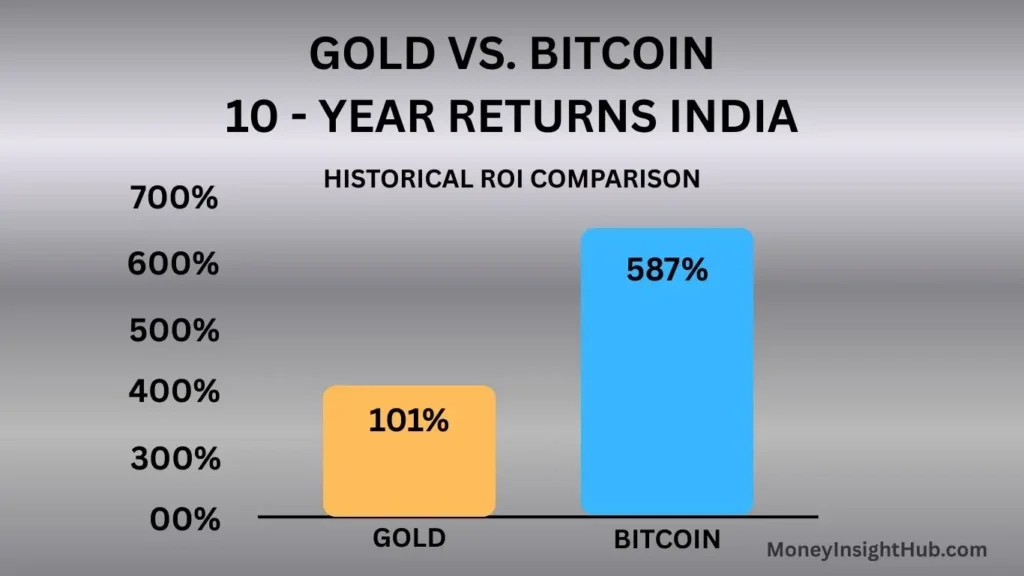
Average annualised return
| Index | Last year | Last 5 years | Last 10 years |
|---|---|---|---|
| Bitcoin | -14.4% | 36.6% | 71.4% |
| Gold spot price | 44.4% | 19.8% | 13.7% |
Total return
| Index | Last year | Last 5 years | Last 10 years |
|---|---|---|---|
| Bitcoin | -14.4% | 375.2% | 21,845.0% |
| Gold spot price | 44.4% | 146.3% | 261.0% |
Investment Potential of Gold and Bitcoin : Bitcoin vs Gold
Gold is considered a mature asset, having served as a store of value for thousands of years. Its total addressable market (TAM) represents a significant share of global store-of-value assets. Some argue that gold could capture an even larger portion of this market as investors seek alternatives to fiat currencies, reinforcing its investment appeal.
Gold’s current market capitalization stands at approximately $29 trillion—over ten times that of bitcoin. Despite this, bitcoin’s TAM may be even greater than gold’s due to its superior properties as both a store of value and a medium of exchange. If bitcoin were to capture 50% of the total store-of-value market, its TAM would be roughly 100 times its current valuation, suggesting a significantly higher investment potential.
Investment Potential of Gold and Bitcoin : Bitcoin vs Gold
Gold is considered a mature asset, having served as a store of value for thousands of years. Its total addressable market (TAM) represents a significant share of global store-of-value assets. Some argue that gold could capture an even larger portion of this market as investors seek alternatives to fiat currencies, reinforcing its investment appeal.
Gold’s current market capitalization stands at approximately $29 trillion—over ten times that of bitcoin. Despite this, bitcoin’s TAM may be even greater than gold’s due to its superior properties as both a store of value and a medium of exchange. If bitcoin were to capture 50% of the total store-of-value market, its TAM would be roughly 100 times its current valuation, suggesting a significantly higher investment potential.

Volatility and Stability
Because bitcoin is a newer and smaller asset than gold, its volatility has historically been much higher. In the short term, its price can fluctuate significantly due to uncertainty about its future and relatively low global adoption. As a result, many investors favor gold for its greater short-term price stability.
Bitcoin vs Gold as a Medium of Exchange : Bitcoin vs Gold
Bitcoin’s verifiability, portability, and divisibility have made it an efficient transaction alternative to fiat currencies. Its network effects are strong and its liquidity continues to spread around the world.
Gold is impractical as a medium of exchange; it lacks the divisibility, portability, and network effects to be effective for transaction purposes. Crossing borders with large quantities of gold is unfeasible and leads to confiscation.
The Risks of Centralization and Confiscation : Bitcoin vs Gold
The Bitcoin network is decentralized. No government, entity, or individual can control the supply of bitcoin or ban anyone from transacting or buying bitcoin. The decentralized nature of bitcoin also eliminates the potential for a single point of failure in the network. Several national governments, including India, China, Turkey, and Nigeria, have attempted to ban Bitcoin. However, no government has been successful, and in most cases government attempts to ban or confiscate bitcoin have led to increased use of the currency within their borders.
The mining and sale of gold is nearly monopolized by several large multinational corporations. Gold supply can be interrupted by internal corporate disputes, labor rights protests, and national or international conflicts. In addition, there have been many documented labor rights and environmental regulation violations associated with gold mining operations.
There is a historical precedent for national governments to successfully confiscate privately held gold. The US government confiscated privately owned gold in 1933 to eliminate the gold standard and artificially prop up the value of the dollar during the Great Depression. Gold has been confiscated en masse in many countries across the world, including Communist China, the United Kingdom, and Soviet Russia.
Gold is inherently more susceptible to confiscation due to its physical nature. Gold is heavy and visible, making it more difficult to secure, transport, and hide from would-be expropriators. Thus, a vast majority of gold is held with custodians such as banks. These banks are subject to regulations and legal action, making them easy to coerce.
On the other hand, bitcoin is not physical—proving that an individual owns bitcoin is rather difficult. Bitcoin can be easily self-custodied, making mass confiscation extremely inefficient. Bitcoin can only be moved with the correct private key, which a bitcoin owner can hide or deny knowledge of more easily than with gold.
As a result of these differences, and in part due to how long gold has been around, a far larger share of all the gold is being held by governments than is the case for their bitcoin holdings through confiscations from various companies.
Divisibility and Portability of Bitcoin vs Gold
A single bitcoin is divisible into 100 million satoshis, similar to how a dollar can be broken down into 100 pennies. The divisibility of bitcoin allows it to be used to transact in small amounts at a low value, even as the price of one bitcoin grows. By contrast, gold is difficult to divide into small, spendable amounts. Gold is often stored as a bullion worth anywhere between $2,000 and $600,000. To spend gold, an individual would have to melt the bar down, incurring further costs before transacting.
One of bitcoin’s most successful improvements upon gold is its portability. Because of its digital nature, bitcoin can be stored in a software wallet or on a flash drive. Using the Lightning Network, a layer built on top of the blockchain, transactions can occur almost instantaneously, at any time, without delays or fees associated with third-party-mediated transactions.
Gold is extremely difficult to move. Its weight and lack of divisibility significantly impact its portability. Gold is most often stored in a personal safe or a safety deposit box at a bank, which comes with non-negligible counterparty risk and costs.
Liquidity of Bitcoin vs Gold
Both Bitcoin vs Gold are among the most liquid assets in the world, meaning they can be bought and sold easily without impacting their price.
Gold has a deep and established market spanning global exchanges, central banks, and private investors. It is actively traded in the form of bullion, coins, ETFs, and futures contracts. However, the process of buying and selling physical gold can be slow, requiring authentication, transportation, and secure storage. Selling large amounts of gold in physical form may also introduce logistical hurdles and additional costs, such as dealer premiums and assay fees. In contrast, paper gold, such as ETFs and gold futures, offers greater liquidity but introduces counterparty risks.
Bitcoin, on the other hand, is traded 24/7 on global cryptocurrency exchanges, offering instant settlement and high liquidity, even for large investors. Unlike Bitcoin vs Gold does not require physical handling, making it easier to transfer across borders and trade in real time. However, liquidity can vary across exchanges, and market depth may fluctuate during periods of extreme volatility.
Accessibility of Bitcoin vs Gold
Gold’s accessibility is largely dependent on physical availability and infrastructure. While gold can be purchased from banks, dealers, and online marketplaces, owning and storing it requires secure facilities, insurance, and in some cases, transportation. Many individuals rely on third parties, such as vault storage services or ETFs, to hold gold on their behalf, which can introduce counterparty risk. Additionally, moving gold across borders can be challenging due to customs regulations and transportation security concerns.
Bitcoin, by contrast, is highly accessible to anyone with an internet connection. It can be acquired instantly on exchanges, brokerages, and via ETFs. Unlike Bitcoin vs Gold does not require physical storage, and ownership is secured through private keys rather than a vault. However, accessibility can be limited by factors such as government regulations, internet restrictions, or technical barriers related to self-custody and security best practices. As of 2026, it is estimated that less than 4% of people worldwide own any amount of bitcoin.
Regulation of Bitcoin vs Gold
In the United States, both Bitcoin vs Gold are regulated as commodities, primarily under the oversight of the Commodity Futures Trading Commission (CFTC). This classification means that both assets are subject to trading rules and anti-fraud regulations in futures and derivatives markets. However, their regulatory treatment diverges significantly in other aspects, particularly regarding taxation, financial reporting, and market accessibility.
Gold has long been recognized as a physical commodity, with a well-established regulatory framework. Bitcoin, while also classified as a commodity, operates in a more fragmented regulatory environment. As Bitcoin adoption increases, regulatory clarity will continue to evolve, potentially leading to a more standardized framework similar to gold.
Utility and Practical Use : Bitcoin vs Gold
Gold has several applications beyond its role as a store of value. Approximately 47% of all gold is used in jewelry, while around 12% is allocated for industrial purposes, including electronics, dental fillings, and aerospace technology.
In contrast, bitcoin, being purely digital, has no utility beyond its function as money. While this may seem to limit its value potential, many consider bitcoin’s singular purpose an advantage, as its price is driven solely by its monetary properties, without influence from external industrial demand.
Environmental Impact of Bitcoin vs Gold
Bitcoin has received criticism for its perceived environmental impact. In practice, Bitcoin mostly uses stranded energy that would otherwise go to waste by being load-shedded. This in turn lowers the cost of electricity for consumers as more revenue is generated by electricity companies. At the same time, Bitcoin mining incentivizes the rollout of renewable energy generation in places that lack consistent demand to make these models feasible.
Meanwhile, gold mining is highly destructive to physical environments. This can lead to mass-scale pollution of both land and water, affecting anyone or anything that inhabits those areas.
Conclusion : Bitcoin vs Gold
Bitcoin vs Gold are commonly compared, but bitcoin has improved upon gold as a hedge against inflation and as a medium of exchange in many ways. The bitcoin supply is absolutely finite, while gold is only relatively scarce. The authenticity and transaction history of bitcoin is easily verifiable by any individual while auditing the gold supply and authenticating any gold is cost-prohibitive and time-consuming, if at all possible.
No government has successfully mass confiscated or banned bitcoin, while the US and many other governments have historically seized privately owned gold. Finally, bitcoin offers superior divisibility and portability to any currency, but especially gold.
FAQs : Bitcoin vs Gold
1. Is gold safer than cryptocurrency?
Yes, gold is far less volatile. It has a centuries-old history as a store of value. Crypto is unstable and more uncertain.
2. Which gives better returns: gold or crypto?
Crypto has paid much greater returns over time, in particular in bull runs. But these come with high risk. Gold generates stable, moderate returns.
3. Should both be held?
Having both is a way to balance between stability and growth, and leverage downside risk, but still have upside potential. A balanced portfolio usually works appropriately.









франшиза магазинов низких цен условия https://oneprice.shop/
http://google.com.kh/url?q=http://oneprice.shop
Creo que muchas veces el trabajo legal es invisibilizado, y este despacho lo hace bien.
Ежели организуете поездку в Потсдам и думаете, что посетить за один день, обязательно советуем уделить внимание на дворец Сан-Суси, Голландский квартал и японский сад. Помимо традиционных достопримечательностей Потсдама, стоит заглянуть в кинопарк Бабельсберг и замок Вальдек, чтобы составить всестороннее представление об этом прекрасном городе. Для любителей природы здесь также обилие парков Германии, где можно отлично провести время и восхититься красотой ландшафта.
Коли вам любопытно, что взглянуть на в Дюссельдорфе, не проигнорируйте блошиный рынок с его неповторимой атмосферой и многообразием товаров (адрес и расписание несложно найти на александровка потсдам ), а также японский парк, который когда-то назывался японским садом Дюссельдорфа. Энтузиастам энергичного отдыха и совместного с семьёй времяпрепровождения придётся по душе Фантазия Ленд — рекомендуем заранее проверить с ценами на билеты и аттракционами. Настолько многообразные направления обеспечат ваше путешествие по Германии полным и запоминающимся.
Если вы планируете отдых на озере Шира, нужно заранее ознакомиться с местами отдыха на Шира. Наиболее популярны базы отдыха Шира Жемчужный и База отдыха Три Звезды Шира, где есть возможность снять хорошие домики по справедливой цене и насладиться уютом, например, базой отдыха Шира с бассейном. Для фанатов природы рекомендую обязательно посетить Сад камней Шира — это великолепное место для прогулок и расслабленного отдыха у воды.
На портале базы отдыха шира жемчужный вы сможете найти развернутую информацию о жилье на Шира, охватывая базы отдыха на Шира и озеро Шира базы отдыха с разным уровнем комфорта. Еще рекомендую взглянуть на варианты домиков Жемчужный Шира и базы отдыха с бассейном, которые превосходно подойдут для семейного отдыха. Не оставьте без внимания про исключительную атмосферу и развлечения, вроде катекс Шира или «Бегущая по волнам» — это придает отдых на Шира намного более запоминающимся.